
Finding Residents Across Surprise
A Surprise residents directory search works best when it begins with the clue already in hand. A street address belongs first in the Maricopa County Assessor search. A person’s name can be tested against property, recorded-document, court, business, and historical indexes. A case number should go straight to the court that owns the file. Older addresses call for regional directory books, census schedules, deeds, and plats.
Official rolls describe roles, not a complete household. An assessor names an owner and may show a different tax mailing address. A deed names grantors and grantees, the parties transferring title. A court index labels parties to a case. None proves that every named person lived at the linked address. Renters and relatives may never appear in a property record. Use two independent sources before treating a match as the same person.
- Search the county property roll by the known name, address, APN, subdivision, city, or ZIP.
- Use the Arizona voter portal only to verify the details of a voter whose identifying facts are already known.
- Follow an owner into the Recorder’s grantor and grantee index, narrowing common names by date and document type.
- Check the Arizona Memory Project for past households in regional name and street directories.
- Send a narrow public-record request to the city department when permits, local cases, or administrative records are not indexed online.
Surprise Parcel Directory Starts Here
The Maricopa County Assessor property search is the strongest first stop for a current address. Its single box accepts an APN, full owner name, formatted address, subdivision, MCR, city, ZIP, section-township-range, business account, or mobile-home VIN. An APN is the assessor’s parcel number. A situs address is the physical location of the land, while a mailing address is where the owner receives tax mail.
A parcel result can supply the owner, situs address, separate mailing destination, legal description, subdivision, values, property features, tax links, and deed or sale references. Trust and company ownership is common enough in Surprise that a business-name result should not be forced into a personal identity. Follow a trust or LLC through the Recorder’s Business Name field and, when relevant, the Arizona Corporation Commission entity search.
The official search screen shows how broad the accepted input can be. Open the Assessor search before comparing the captured controls below.
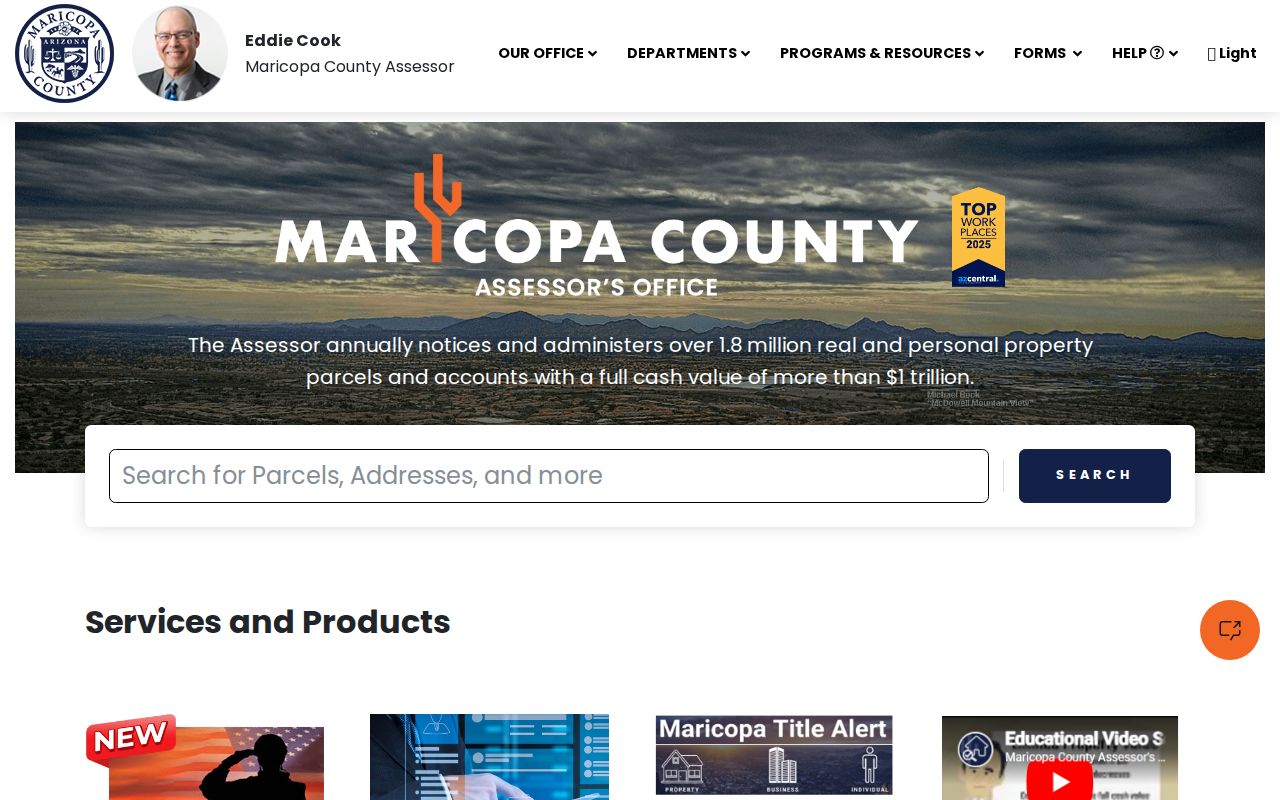
The image ties the search process to the county source that maintains the parcel roll, rather than to a commercial name compilation.
Custodians Behind Surprise Records
Surprise is not the county seat and does not keep the core deed, probate, marriage, assessment, or general court corpus. Maricopa County offices hold those records. The City Clerk and separate city departments keep municipal files such as council records, permits, code matters, police and fire requests, and City Court material. Arizona agencies control statewide voter, vital, corrections, licensing, and business sources. Sending the same broad request to every office slows the search. Match the question to the custodian that created the record.
Surprise City Clerk
16000 N. Civic Center Plaza
Surprise, AZ 85374
623-222-1000
Arizona Public Records Law, chiefly A.R.S. §§39-121 through 39-121.03, calls for prompt access rather than one universal deadline. A precise request names the department, date range, address, case or permit number, file type, and preferred format. The Surprise street directory follows the detailed address chain without repeating the office map here.
Surprise Deed Records Span Eras
Maricopa County’s recorded-document corpus begins in 1871. County reporting in 2022 described more than 52 million searchable documents and a modern name-indexing pace of about 72 hours. That long run predates Surprise’s 1938 origin by more than six decades. Early land tied to the future community may therefore appear under legal descriptions, subdivisions, book and page references, or a regional place label instead of a modern street.
The Recorder search supports recording number, docket or book and page, business name, personal last and first names, document code, date range, and Internet Map Locator references. A deed index entry can reveal recording number and date, document type, grantors, grantees, page count, cross-references, and image status. The image is unofficial unless purchased and certified through the Recorder. Search spelling variants and reverse party roles when a chain goes cold.
- Grantor
- The party transferring an interest in real estate.
- Grantee
- The party receiving that recorded interest.
- Legal description
- The lot, block, subdivision, or survey wording that identifies land beyond a street label.
- Index
- A finding aid that points to a recorded instrument, not always the official certified copy.
Note: A free Recorder image is useful for research, but an office-certified copy is the record to request when formal proof is required.
Present-Day Surprise Directory Sources
No current official Surprise residents directory lists every household. Instead, several purpose-built rolls cover different groups. Choose the source by the fact that needs confirmation, then read the person’s displayed role. Property ownership, voter registration, a court appearance, and a business filing are distinct facts.
| Official source | What a name can mean | Custodian | Public route |
|---|---|---|---|
| Property roll | Owner, trust, or entity tied to a parcel | Maricopa County Assessor | Free web search |
| Recorded documents | Party to a deed, lien, release, plat, or judgment | Maricopa County Recorder | Free index; copies priced separately |
| Voter information | A voter whose supplied identity details match | Arizona Secretary of State | Individual verification portal |
| Court indexes | Named party with a stated case role | City, county, state, or federal court | Index or clerk request |
| Entity filings | Agent, principal, manager, or business contact | Arizona Corporation Commission | eCorp entity index |
A focused Surprise resident lookup can combine those sources when the goal is one person. A missing result is not proof that someone has no record. Protected addresses, sealed cases, spelling changes, delayed updates, and databases built for self-verification all limit what an open search can show.
Voter Lookup Confirms, Not Browses
The Arizona Voter Information Portal is not a public street roster. It asks for identifying information to return registration and polling details for the voter being checked. Broader voter-file access is governed by A.R.S. §16-168, with permissible-use limits, excluded fields, fees, and penalties. A.R.S. §16-153 also provides protection for qualifying voter records.
This creates an important comparison in the Surprise residents directory. The Assessor lets a user browse parcel owners by address or geography. The voter portal verifies a supplied identity. Treating both as open lists would misstate the tools and could expose protected people.
Visit the official voter portal to see the identity-checking entry point.
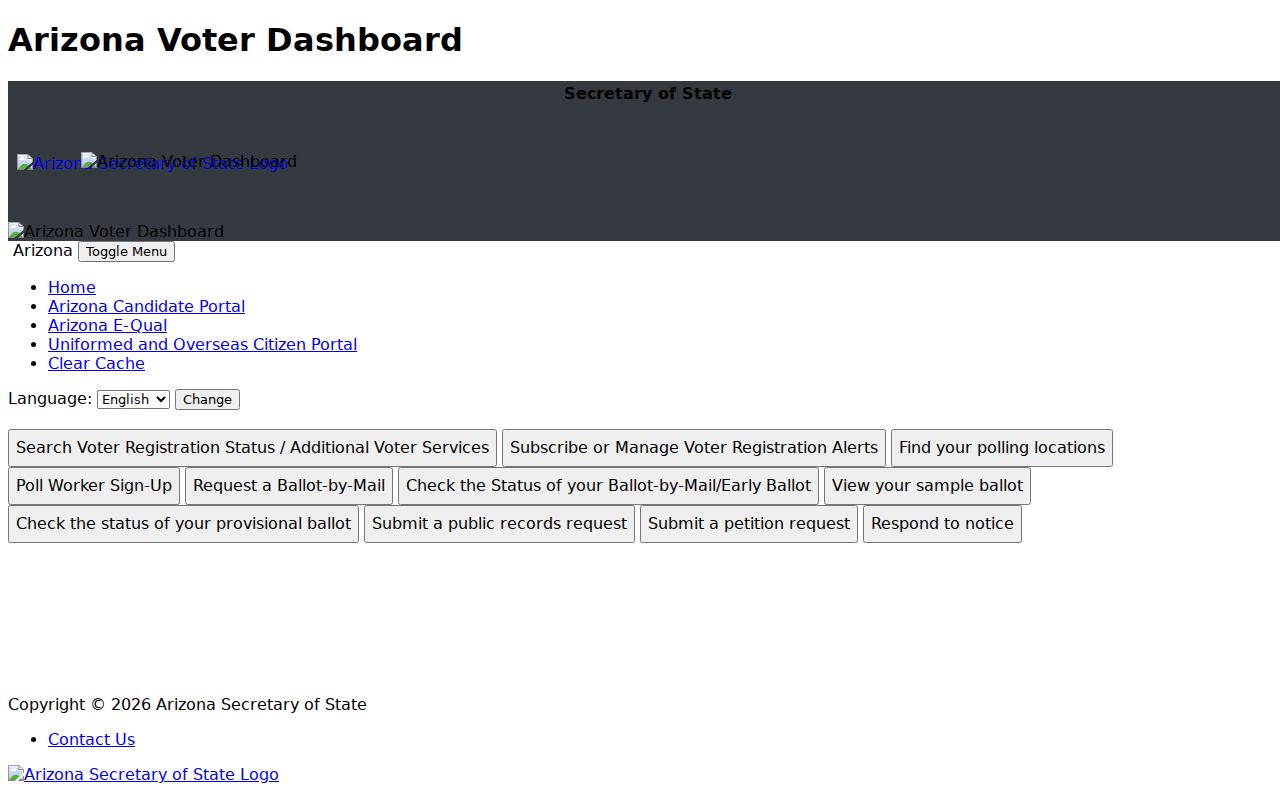
The captured page reinforces that voter information is reached through personal verification, not through a ZIP or block browse.
Use records lawfully. Search public information for genealogy, reconnection, estate work, consumer safety, and civic research. Never use it to stalk, harass, intimidate, or evade an address protection.
Surprise Court Records Need Context
Surprise City Court handles city-code matters, criminal misdemeanors, and civil traffic cases. Maricopa County Justice Courts hear limited-jurisdiction cases. The Superior Court handles felony, civil, probate, family, divorce, and other general-jurisdiction matters. Federal cases belong to the U.S. District Court for the District of Arizona and PACER. One name can therefore appear in several systems for unrelated reasons.
The Arizona Public Access portal searches participating courts by a last name with optional first name, date of birth, court or county, and case type, or by case number. It is informational, updated weekly, and not the official court record. The index excludes categories such as sealed cases, protection orders, mental-health material, probate information, victim or witness data, juvenile matters, and local-ordinance charges. A no-result cannot rule out a file held by a clerk.
| Search field | Use | Limit |
|---|---|---|
| Last name | Required for the name path | Common names need more facts |
| First name | Narrows party matches | Variants and initials matter |
| Date of birth | Separates similar names when offered | Display may be partial or restricted |
| Court or county | Focuses the jurisdiction | Not all courts and cases participate |
| Case number | Direct route to a known index entry | Verify the file with its clerk |
Four Surprise Family Record Paths
Birth, death, marriage, and divorce records do not share one custodian. Arizona Department of Health Services and the county registrar issue eligible birth and death certificates. Those records are restricted under A.R.S. §§36-324 and 36-342. The State Archives receives birth certificates after 75 years and death certificates after 50 years under §36-351, creating a separate historical route for genealogy.
Marriage licenses come from the Clerk of Superior Court in Maricopa County. Divorce is a Superior Court case, and a decree must be requested from the Clerk subject to sealing and confidential-field rules. At the Northwest Regional Court Center in Surprise, the clerk handles marriage licenses and other clerk business. The published marriage license fee is $98, while recorded certified-copy fees differ by order method and should be checked before payment.
The Arizona vital-records hub explains the eligibility and order routes shown in this capture.
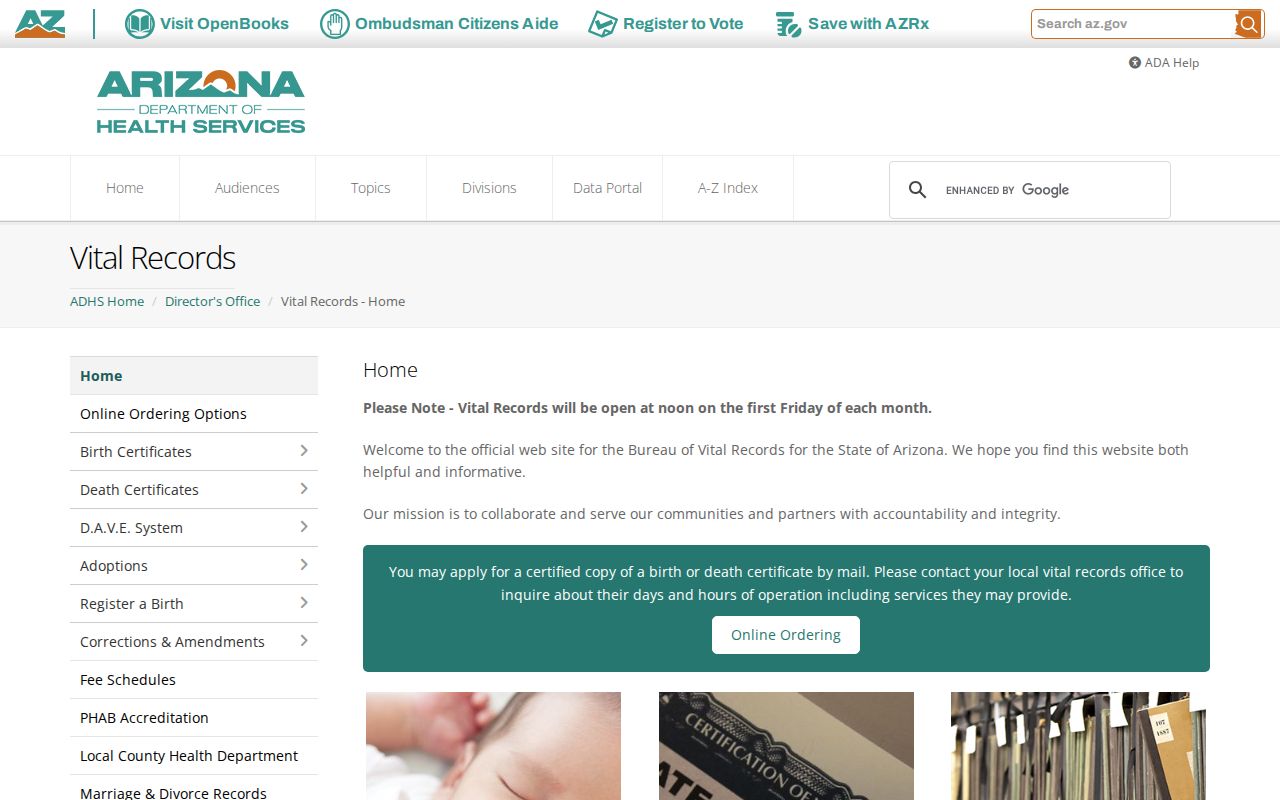
The hub is the proper source for current forms, identification rules, and fees; historical open certificates follow the State Archives path.
Surprise City Records Use Departments
Municipal records do not all sit behind one counter. The Surprise public-record request page routes City Court, Fire-Medical, Police, and other requests through department-specific paths. Development Services is the right target for historical permits, applications, inspection logs, certificates of occupancy, and releasable plans. Code files should be requested separately because planning, building safety, and enforcement systems may use different indexes.
A strong property request gives both the street address and APN, states a date range, separates the record types, and asks for native electronic files where available. Names in permits must stay tied to their role, such as owner contact, applicant, contractor, or designer. The record does not prove residence.
The official request routing screen shows the city’s current department choices.
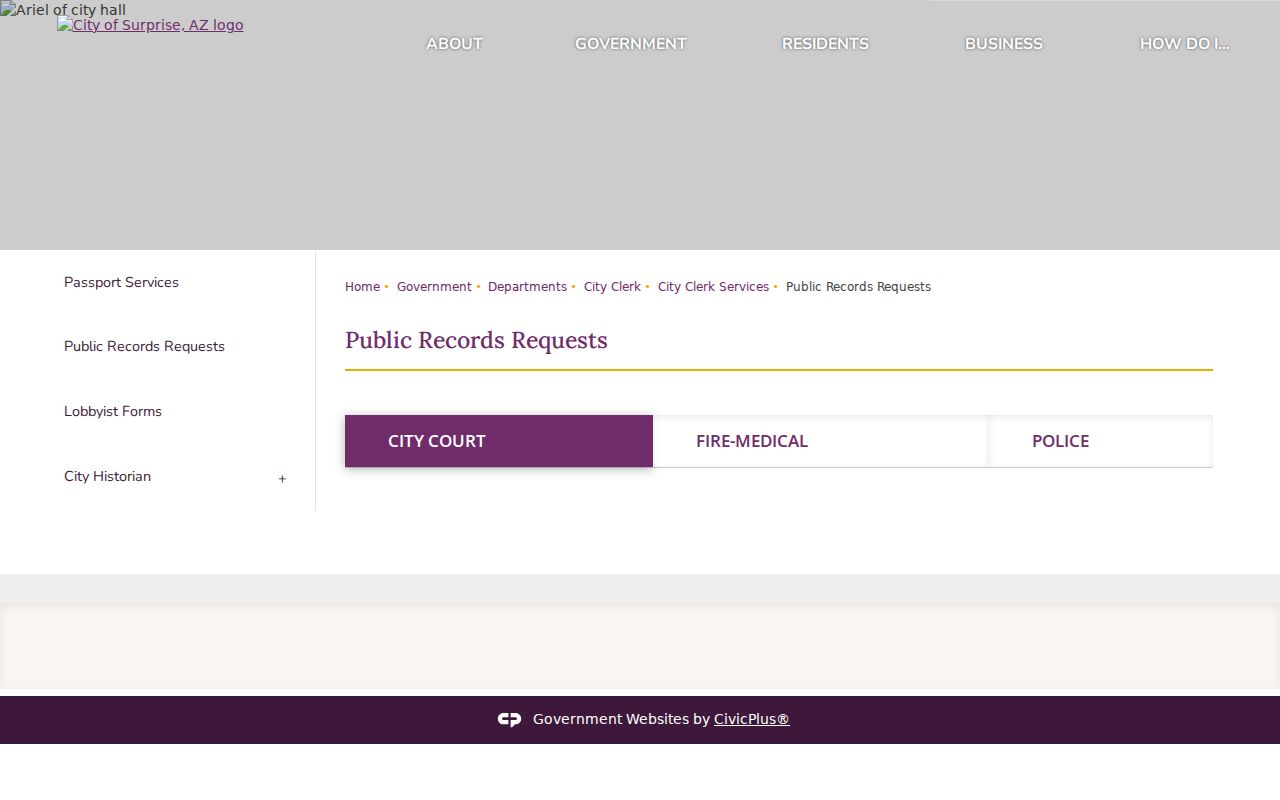
The capture helps direct a request to the office that owns the file instead of sending an unfocused demand to City Hall.
Note: Arizona law calls for prompt production, but archived, broad, or redaction-heavy requests can take longer than a narrow request.
Surprise Directory Books Go Regional
The Arizona Memory Project’s City Directories collection spans 1881 through 1989 overall and reports nearly 400 directories across Arizona. Exact place tagging confirms six digitized volumes that include Surprise: Mullin-Kille Glendale ConSurvey books from 1957, 1959, 1961, and 1963, plus Cole’s Greater Phoenix cross-reference volumes from 1962 and 1963. This proves those scans include the community. It does not prove that no other print volume does.
An alphabetic directory may show a name, spouse, occupation, employer, home address, telephone, and home-ownership symbol. A reverse or criss-cross book starts with street and house number. Search broad regional labels because early Surprise households can appear in Glendale, Greater Phoenix, or Salt River Valley coverage. One 1963 entry even displays dual numbering for N Factory, a warning to try both visible address forms without inventing a citywide renumbering date.
The full shelf and search method belong to the Surprise city directory collection page. Directory evidence grows stronger when paired with the 1930, 1940, or 1950 census, a deed, a vital record, or probate material.
Surprise Record Geography Changes Searches
Postal labels, city limits, and county record jurisdiction overlap without matching. USPS controls delivery names and ZIP codes. Surprise controls municipal services inside its boundary. Maricopa County keeps the assessor, deed, and core court systems. A parcel can carry Surprise jurisdiction, a postal label from another community, and an owner mailing address in a third city, all without contradiction.
This matters along growth areas and borders. The city’s planning area is much larger than its incorporated footprint, and the 2023-24 Community Profile described about 110 incorporated square miles within a planning area above 300 square miles. Asante, Marley Park, Rancho Gabriela, Greer Ranch, Surprise Farms, Sierra Montana, Sterling Grove, City Center, Bell Road, Grand Avenue, Loop 303, Railplex, and North Surprise can work as subdivision or map clues. They are not substitutes for an APN or legal description.
New northern and western addresses are often easiest to trace through parcel, plat, and permit systems. Original Town Site and mid-century addresses may also reach the regional books. That split is one reason the Surprise residents directory must use more than a modern name box.
Verify Every Surprise Resident Match
Before accepting a result, compare the full name, middle initial, age or date clues, address dates, relatives, and the role shown in each record. Prefer two independent official sources. A court index should be checked against its clerk. A deed image should be read for vesting and legal description. A business filing should be described as a company role, not a home address. An unclaimed-property result is only a lead until the claimant proves identity and ownership.
Corrections must go to the source. The Assessor handles parcel-roll errors, the Recorder handles indexed instruments and recorded corrections, a court clerk handles docket or file issues under court rules, and the voter office handles registration. Removing a result from a private publisher does not erase the official source record.
An Arizona Unclaimed Property search can add a locality clue when a name has gone cold.
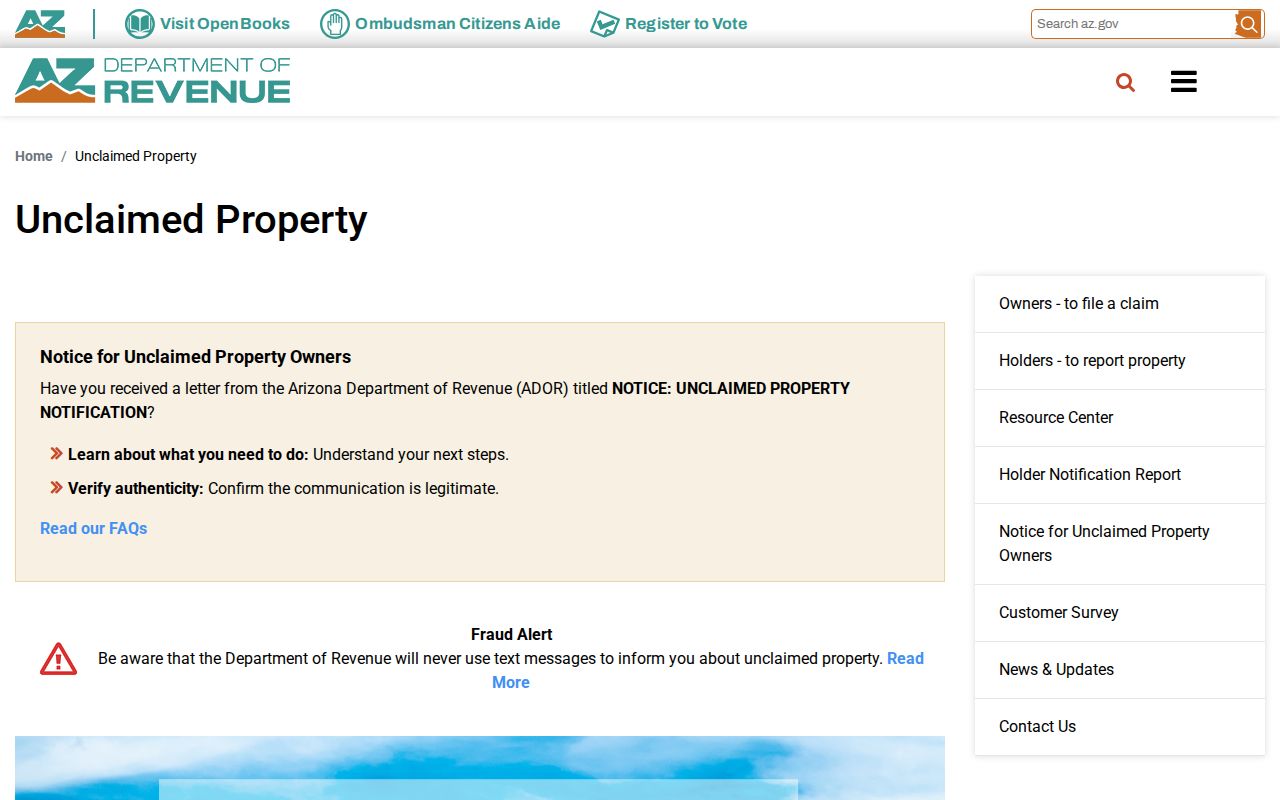
The official search is free, but a possible name and city match remains only a lead until the claimant proves identity and ownership.
Identity check. A shared name is not enough. Confirm role, place, time, and one other stable fact before linking a Surprise record to a person.
Public records change. Protected addresses may be sealed, vital certificates can be closed, and some court categories never appear in the public index. Responsible use keeps uncertainty visible and describes only what the source can support.