
Surprise Resident Lookup Records
No single Surprise index proves where a person lives. Each official record establishes a narrower fact. The Maricopa County Assessor identifies the titled parcel owner, situs address, and tax mailing destination. The Recorder connects names to recorded deeds. Courts show a named party and the role that person held in a case. The voter portal tests details supplied by the user, while a vital certificate is available only through the access path allowed for that record.
| Record | What It Confirms | Where | Access |
|---|---|---|---|
| Assessment roll | Parcel owner, situs, tax mailing destination | Maricopa County Assessor | Free search; ownership is not occupancy |
| Recorded deeds | Name variants, transfer, return address, title chain | Maricopa County Recorder | Free index; image and copy access vary |
| Voter status | Supplied identity matches a registration | Arizona Voter Information Portal | Verification fields; protected by state law |
| Court index | Party role, case number, dates, and status | City, county, and statewide systems | Index is a lead; clerk holds the official file |
| Vital and family records | Eligible birth or death facts, marriage, divorce | ADHS, county registrar, or court clerk | Eligibility, archive, and copy rules differ |
| Business and license files | Entity role or public credential status | ACC eCorp or the relevant board | Business contact is not a home address |
Choose the first source by the question. A known Surprise address points to the Assessor. A case number points to the court that heard it. A company name belongs in the Corporation Commission index. Family history may call for probate, an obituary, or an archival certificate. A strong resident lookup keeps the labels attached: owner, voter, party, agent, spouse, or heir. Those roles are evidence, not interchangeable claims of residence.
Confirming One Surprise Resident
Common names are the main source of false matches. Preserve the middle initial, suffix, former surname, and exact role shown in each Surprise record. Dates must also form a sensible sequence. An owner named on a deed should not be merged with a court party merely because the first and last names match. Compare an APN, legal description, spouse, known business, or other independent fact. The research standard is simple: require two facts from separate sources before treating records as one identity.
- Anchor the name to a known Surprise fact. Use a parcel, old address, company, case number, or documented family relationship.
- Search spelling forms, full first names, middle initials, suffixes, and prior surnames. Keep each result separate at first.
- Compare dates, places, and roles. A tax mailing address can differ from both the parcel and the owner’s home.
- Open the underlying record or request it from the custodian. Record the source and the date checked.
When a result conflicts, the office that maintains it is the correction point. Send the custodian the record identifier and proof supporting the change. A commercial compilation cannot amend the source assessment, deed, docket, or registration. For a historic trail, the Surprise Directory Book collection can supply older name and address clues, but those clues still need to be paired with official records.
Note: A tax mailing address shows where notices go, so it should never be presented as proof of a Surprise resident’s current home.
Surprise Court Lookup Clues
Surprise court records are split by jurisdiction. Surprise City Court handles city-code, misdemeanor, and civil-traffic matters. Maricopa County Justice Courts cover limited matters, while Superior Court holds felony, civil, probate, family, and divorce files. The statewide Public Access to Court Information system searches participating courts by party name or case number. It warns that its data is not the official court record and may omit cases.
The name path uses a required last name, with first name, date of birth when offered, court or county, and case type as narrowing fields. Results can include the case number, court, filing date, party names and roles, hearings, broad claim or charge labels, and disposition. Read the role and status before drawing any conclusion. Sealed cases, probate, juvenile material, orders of protection, and other protected categories are excluded from the statewide view.
The Arizona Superior Court eAccess service shows how document access differs from a public name index.
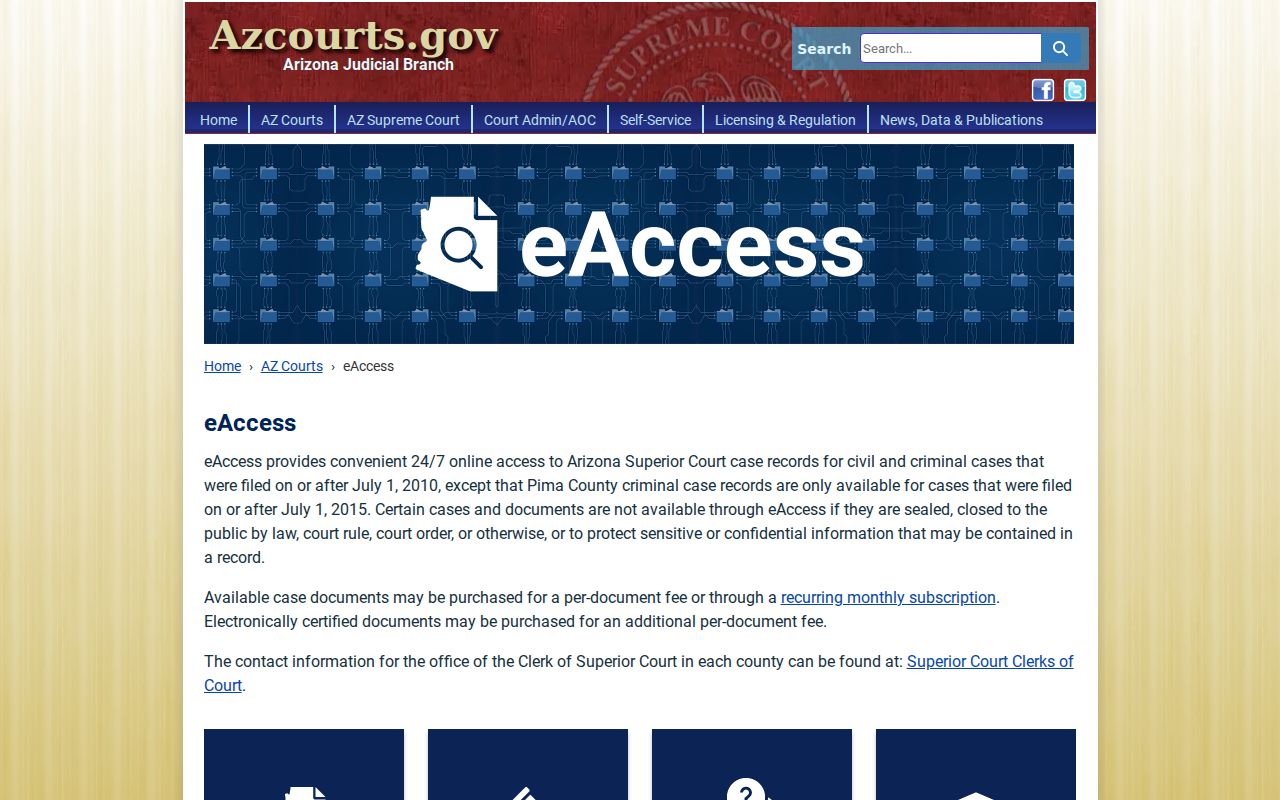
That screen is a route to eligible file images, not proof that every Arizona case or confidential document is available. The Maricopa County Justice Courts also provide their own case and records channels.

The Justice Courts image reinforces the jurisdiction check: identify the court first, then ask its clerk for public files, an official copy, or an older archived record.
Verifying Surprise Resident Results
A portal result and an official copy serve different needs. The index helps locate a record. An image shows the filed content when access is allowed. A certified copy carries the custodian’s formal certification. For Maricopa court files, public terminals can support free inspection, while the clerk handles copies and certifications. Surprise City Court requests may go through My Surprise, in person, by mail, or by fax. A narrow request should state the case number, party, date range, and exact item needed.
- Docket
- The running list of filings, hearings, and court events in a case.
- Index
- A finding aid with basic record facts. It is not always the filed document.
- Image
- A scan or electronic view of the record, subject to access and redaction rules.
- Certified copy
- A copy formally authenticated by the office that keeps the record.
For one Surprise resident lookup, save the case number and court name even when no image appears. Contact the proper clerk rather than asking another office to interpret the person. A clerk can explain copy steps and public access. The clerk should not be expected to identify which same-name party is the person being researched.
Surprise Voter Identity Check
The Arizona Voter Information Portal is a self-verification tool. It is not a public directory of Surprise voters. The form commonly asks for Maricopa County, first and last name, date of birth, and an identification path as presented. A successful match can confirm registration status, district context, polling information, or ballot-status services based on details already supplied. It does not reveal a stranger’s address through a casual name search.
A.R.S. §16-168 limits voter-file use and internet redistribution. Ordinary public access withholds month and day of birth, Social Security number, driver or nonoperating ID, signature, email, and other protected identifiers. Voter history reports participation, never a person’s ballot selections. Qualifying voters can have identifying information sealed under A.R.S. §16-153, and the protection may extend to other voters in that household.
| Portal Field | How It Works |
|---|---|
| County | Select Maricopa for a Surprise registration. |
| Last and first name | Match the registration spelling as presented. |
| Date of birth | Used to verify identity, not for public browsing. |
| Identification credential | A driver, nonoperating, or voter ID path may be offered. |
Surprise Vital Record Thresholds
Arizona vital records are not an open resident lookup. Under A.R.S. §§36-324 and 36-342, certified birth and death copies are limited to authorized applicants who provide identification and evidence of the required relationship or legal interest. Surprise events may be ordered through the Maricopa County Office of Vital Registration or the Arizona Bureau of Vital Records, depending on the request.
Historical access follows a different clock. A.R.S. §36-351 sends birth certificates to the State Archives after 75 years and death certificates after 50 years. Marriage licenses are kept by the Clerk of Superior Court, while divorce decrees come from the related court file. A missing vital result can reflect eligibility, archival timing, spelling, delayed registration, or the wrong custodian. It does not prove the event never happened.
Earlier family research may need church, cemetery, newspaper, or territorial sources. ADHS began statewide birth and death tracking in July 1909. Delayed birth records contain evidence supplied later, so they should be labeled as delayed registrations rather than records made at the time of birth.
Note: Birth, death, marriage, and divorce facts follow four distinct Surprise and Arizona access paths, so one office cannot answer every request.
Finding Surprise Heirs Lawfully
Family and estate research is a useful human purpose for a Surprise resident lookup. Begin with a documented death or obituary lead. Then search the Maricopa County probate path for a case number and public party roles. Petitions, notices, and recorded beneficiary deeds may connect a deceased owner to an heir, subject to redaction and court access rules. The statewide court index excludes probate, so a no-result there is not the end of the search.
Pair the probate lead with the current parcel and deed chain. The Assessor can identify a titled owner, and the Recorder can show a transfer or beneficiary instrument. The legal description guards against same-name errors. Obituaries can suggest family relationships, but those claims should be checked against probate or eligible vital evidence. Adoptees and birth relatives must use Arizona’s official confidential adoption and court mechanisms rather than trying to bypass restricted vital records.
Identity rule. Keep decedent, petitioner, heir, personal representative, deed grantee, and current owner as separate roles until two independent facts connect them.
Surprise Business Role Lookup
Trusts and LLCs often appear in Surprise property records, especially in master-planned and retirement communities. Search an Arizona corporation or LLC through the Arizona Corporation Commission eCorp system, not the Secretary of State. Entity name, entity ID, and statutory-agent or person-name paths may lead to legal name, type, status, formation date, known place of business, statutory agent, principals, managers, and filing history.
The displayed address must retain its label. A known place of business or statutory-agent address is not proof of a home. For a professional credential, use the Arizona professional license directory to reach the relevant board. Board records can confirm license class, status, and public discipline where provided. A county assumed-name trail or recorded business document may require the Recorder or clerk route.
When the Assessor names a trust or LLC, search that exact business name in recorded documents and eCorp. Then compare deed dates, entity filings, and the parcel legal description. This bridges official roles without guessing who occupies the Surprise address.
Surprise Records Request Fallback
Online searches have real gaps. Older files may sit in paper, microfilm, a clerk terminal, or a department archive. Arizona Public Records Law, A.R.S. Title 39, supports a narrow request to the office that created and maintains the record. Name the record series, subject, address, case or permit number, and date range. Ask for an index or list when the underlying file contains restricted material.
Surprise municipal files are routed through the city public-record request system. City Court, Police, and Fire-Medical have distinct channels. Maricopa County remains the keeper for deeds, many court matters, voter administration, and property data. Certified birth and death requests go through vital-registration rules. Sending the same broad question to City Hall, the Assessor, and the Clerk wastes time because each office controls a different record.
A good fallback request seeks records, not conclusions about a person. Ask for a permit card, public docket, deed copy, or releasable index. If the answer is “not located,” preserve that wording. Protected addresses, sealed cases, incomplete indexing, and jurisdiction mistakes can all explain a missing hit.
Limits on Surprise Resident Lookup
Arizona’s Address Confidentiality Program gives eligible survivors a substitute mailing address and mail forwarding. Enrollment is handled through a registered Application Assistant. Separate court processes under A.R.S. §§16-153 and 11-483 can restrict voter or property-related identifying information for qualifying people. Those protections suppress public display while preserving authorized government use. A careful Surprise resident lookup calls a missing result “not located” instead of claiming that no record exists.
Commercial compilation tools combine public and nonpublic feeds. They can lag, blend same-name people, and repeat old addresses. Official records are better for confirming the narrow fact each custodian keeps. Removal from a commercial display does not erase the source deed, assessment, or public court record. Errors should be challenged at the source first, with the record number and supporting documents.
Lawful use. Surprise resident lookup records support family research, reconnection, estate work, and civic inquiry. Arizona law prohibits using personal information to stalk, harass, threaten, or harm anyone.